AI AND THE FUTURE OF WRITERS JUDGEMENT By Feisal Mohammed
Right here writers and scholars should make a pause and think.
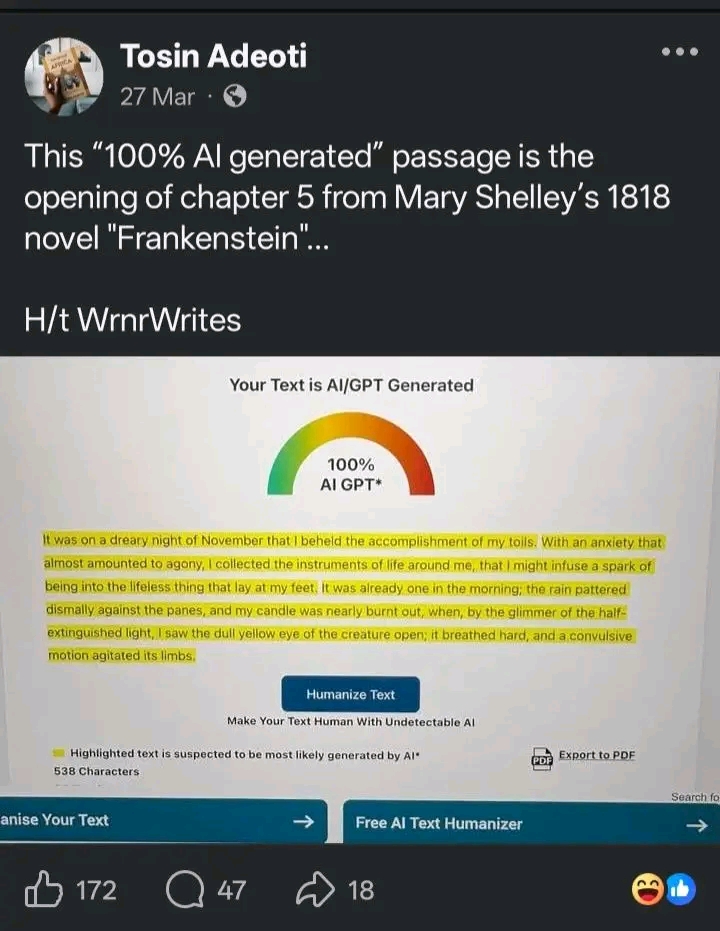
The attached image contain a referencing of Frankenstein, written in 1818 by Mary Shelley. Which is over 200 years ago, before something call artificial intelligence crowned as some writers ink today. Yet an AI detector is confidently flagging that same text were “100% AI generated.”
How? A words written before the AI! This is serious alarm to writers.
What this simply means is that many of these so-called AI checkers platforms are not detecting truth neither words, they after detecting patterns.
And once your writing skills plug high thinking, structure, clarity, and language reach a certain level, It begin to classify it as artificial. Not because it is, but because it resembles what the model trained to expect from high-quality, structured writing.
Making this to our personal careers, There are certain people who don’t know you from Adam and Evi children, they don’t know your process, your background, your discipline, or how long you have been training your mind model. Yet they will look at your work and nailed, “this is AI.” That is one of the most intellectually lazy conclusions I have seen in our own times.
Before AI became mainstream or mere ink, famous writers were already writing award-winning books, nurturing ideas, studying deeply, learning from mentors, and refining their voice over years among the children of Adam.
Can AI detectors be wrong? Yes. Completely.
Tools like GPTZero, Turnitin AI detection, Copyleaks, Originality.ai, and others often produce conflicting results on the same text.
A human pieces of written can be flagged as AI, while an AI-generated text that has been slightly edited can pass as human. That alone tells you the system is not grounded in certainty.
A one writer called ( Osinakachi Akuma Kalu) Personally tested his work, which he has done 10 to 15 years ago, before AI became what it is today. Some of these tools flagged them as AI-generated. That tells everything you need to know. The problem is not the writing. The problem is the detection model.Even worse, some of these platforms now offer “humanizers” that rewrite your work just to beat their own detection systems. So the same ecosystem that claims to detect authenticity is also actively helping people bypass it. That contradiction should not be ignored.
Is using AI as a crutch or a substitute for thinking acceptable? No.
You must know your idea. You must have direction. You must have understand the structure, logic, and depth sense. AI assist thinking, not replace it. If you don’t have intellectual grounding, AI will only amplify confusion. If it didn’t match , it didn’t match!But dismissing someone’s work simply because it sounds structured, deep sense, or refined is not intelligence. It is intellectual disguised skepticism.
Moreover, Writers and scholars need to research before judging a piece of writing,
So that next time they across to see a strong piece of writing, pause before you say “this is AI.”
Ask yourself a better question.
What if this is simply what disciplined thinking looks like?