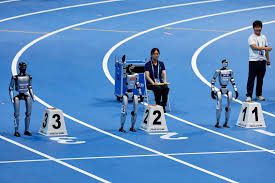
China on Friday opened the World Humanoid Robot Games, a three-day sports showcase featuring humanoid robots from 16 countries competing in events ranging from table tennis and football to track and field. The event, which drew 280 teams including 192 from universities and 88 from private enterprises, highlights Beijing’s ambition to position itself at the forefront of robotics and artificial intelligence.
Robots will not only engage in conventional sports but also demonstrate practical applications in areas such as sorting medicines, handling materials, and cleaning services. Among the competitors are humanoids developed by leading Chinese firms such as Unitree and Fourier, reflecting the country’s growing ecosystem of robotics companies.
The Beijing municipal government is a co-organiser of the games, underscoring the political weight placed on robotics development as China confronts both an ageing population and slowing economic growth. Over the past year, the sector has received more than $20 billion in subsidies, while Beijing is also planning a one trillion yuan ($137 billion) fund to back AI and robotics startups.
This latest showcase follows a string of high-profile robotics events in China, including what was billed as the world’s first humanoid robot marathon in Beijing and the opening of retail stores dedicated to humanoid robots. That marathon, however, drew criticism after several competitors broke down mid-race—some emitting smoke—raising doubts about the readiness of the technology.
Despite such setbacks, industry experts see competitions like the World Humanoid Robot Games as critical testing grounds for advancing embodied intelligence. Analysts at Morgan Stanley noted rising public interest in robotics conferences compared with previous years, calling it a sign that enthusiasm for humanoid technology extends beyond government officials. “We believe this widespread interest could be instrumental for China’s continued leadership in the humanoid race, providing the necessary talent, resources, and customers to boost industry development and long-term adoption,” the analysts wrote in a recent report.
Companies participating in the games share a similar outlook. Booster Robotics, whose humanoids are part of Tsinghua University’s football squad, says the sport provides an effective platform to test and refine perception, decision-making, and control technologies that could later find use in homes, factories, and healthcare. “Playing football is a testing and training ground for helping us refine our capabilities,” said Zhao Mingguo, Chief Scientist at Booster Robotics.