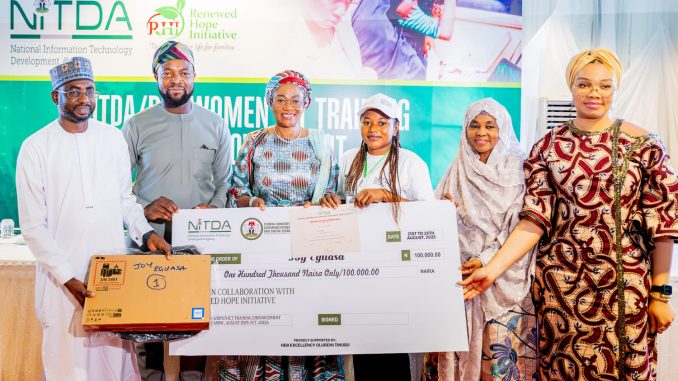
International Women’s Day: Evaluating NITDA’s Drive to Bridge Digital Divide
By Fatimah Yusuf Usman,
As the world basked in the celebration of the “2025 International Women’s Day” themed: “Invest in Women: Accelerate Progress,” the call to action has never been more urgent. Women’s participation in key sectors, especially technology, remains disproportionately low, despite growing evidence that empowering women drives economic growth and societal advancement.
Accelerating action requires more than just words; it demands intentional efforts to dismantle barriers and create opportunities for women to thrive. This year’s IWD theme underscores the need for tangible progress in closing the gender gap and investing in women’s education, skills and leadership.
For Nigeria, where women make up nearly half of the population yet remain underrepresented in the technology sector, this message holds particular significance. Addressing this imbalance is not just about fairness—it is about driving national prosperity.
One organization that has consistently championed this cause is the National Information Technology Development Agency (NITDA). Under the leadership of Director General Kashifu Inuwa Abdullahi, NITDA has been at the forefront of empowering women through technology, implementing strategic initiatives to bridge the gender gap and equip women with the skills to excel in the digital economy.
NITDA’s approach to gender inclusion has been deliberate and far-reaching.
Recognizing that digital literacy is a key driver of economic empowerment, the agency has rolled out numerous training programs designed specifically for women.
These programs cover essential skills in coding, artificial intelligence, data analysis, and cybersecurity—fields that have traditionally seen low female participation.
A notable highlight of these efforts was the DG’s recent attendance at the inauguration of the Quality Education and Girl Child initiatives, organized by the Ministry of Education. During the event, Kashifu Inuwa emphasized the critical role of education in societal transformation and stressed the need to empower women through technology.
He underscored how bridging the gender gap in digital literacy is not just a moral imperative but a strategic move to drive national development. This aligns with the President’s Renewed Hope Agenda, which focuses on education, health, and social investment as essential pillars of national progress.
By equipping women with digital skills and ensuring their active participation in the tech ecosystem, NITDA is contributing directly to this broader vision of inclusive growth. Over the years, NITDA has launched several targeted initiatives to increase women’s participation in the tech industry.
Through women-focused digital literacy programs, the agency has organized training sessions across Nigeria, providing women with practical skills to navigate and excel in the digital space. Support for women-led startups has also been a priority, with funding opportunities, networking platforms, and mentorship programs helping female entrepreneurs thrive.
Additionally, innovation hubs for women have been established, providing collaborative spaces where women can access resources and scale their ideas into viable businesses. These efforts reflect a broader understanding that closing the gender gap in technology requires more than just increasing access—it involves creating a supportive ecosystem where women can lead, innovate, and thrive.
While progress is being made, challenges remain. Structural barriers, ranging from gender bias to unequal access to opportunities, continue to limit women’s participation in the tech sector. Kashifu Inuwa has consistently advocated for policy changes that address these barriers, including promoting gender balance in tech leadership and encouraging more women to take up STEM (Science, Technology, Engineering, and Mathematics) education and careers.
Through initiatives like Digital Youth Nigeria, NITDA has trained thousands of young women in digital skills, helping them break into the tech industry and challenge outdated norms about women’s capabilities in the digital economy. The agency’s approach has been to empower women not just as participants but as leaders and innovators.
Under Kashifu Inuwa’s leadership, NITDA has demonstrated that empowering women through technology is not just about gender equality—it is about national progress. The DG has made it clear that investing in women’s education and skills is a strategic move to strengthen Nigeria’s economy and global competitiveness.
His recent emphasis on aligning NITDA’s gender inclusion efforts with the Renewed Hope Agenda signals a long-term commitment to creating a more equitable society. By investing in women’s digital literacy and supporting women-led innovations, NITDA is helping to build a future where women’s contributions to technology and society are fully recognized and valued.
As the global call to “Invest in Women: Accelerate Progress” echoes this Women’s Day, NITDA’s work serves as a powerful example of what it means to take concrete action. Empowering women in technology is not just about closing the gender gap—it is about unlocking the full potential of Nigeria’s human capital and driving sustainable development.
Kashifu Inuwa’s leadership has shown that investing in women is not only a moral imperative—it is a strategic pathway to national prosperity. By providing women with the skills, opportunities, and support needed to excel in technology, NITDA is helping to create a future where gender equality is not just an aspiration but a reality.
This Women’s Day, the message is clear: empowering women accelerates progress—and NITDA is leading the way.
Fatimah Yusuf Usman, a Mass Communication graduate from Baze University, is a serving corps member at PRNigeria Centre, Abuja. She can be reached via: [email protected].