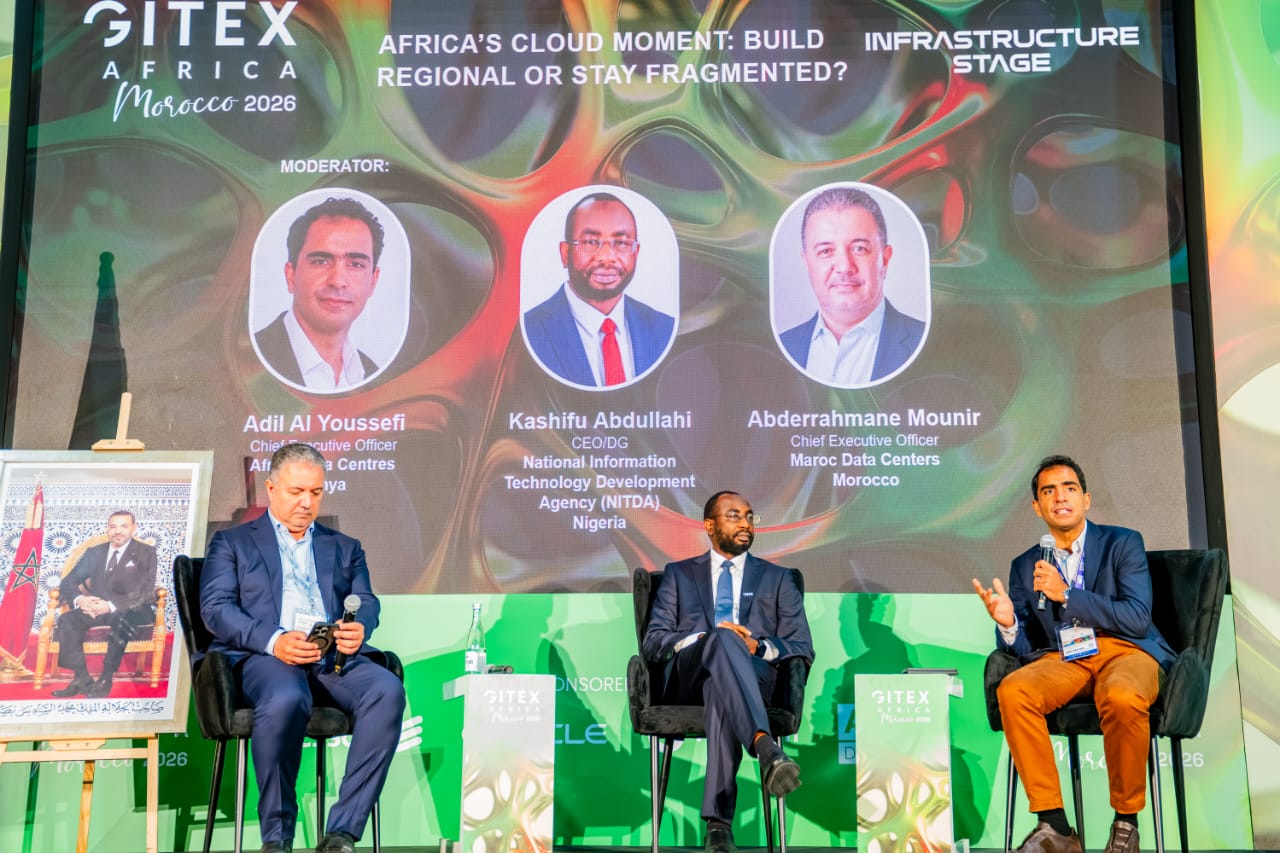
Nigeria has called on African nations to prioritise cloud sovereignty and local data infrastructure as a foundation for digital independence across the continent.
Speaking at the GITEX Africa 2026 in Morocco, Director General of the National Information Technology Development Agency (NITDA), Kashifu Inuwa, warned that reliance on foreign-controlled digital systems could leave Africa vulnerable to external disruptions.
He described cloud infrastructure as central to modern digital life, stressing that control over data storage and processing is increasingly tied to national sovereignty and economic competitiveness.
Inuwa noted that Africa accounts for between 15 and 19 per cent of the global population but holds only about 0.6 per cent of global data centre and computing capacity, describing the disparity as both a technological and sovereignty gap.
He warned that dependence on foreign cloud providers exposes countries to risks related to data security, policy control and economic value extraction, as locally generated data is often processed and monetised outside the continent.
To address this, he advocated a coordinated regional approach, proposing a federated “cloud of clouds” system that would connect national and regional platforms into a unified, interoperable network.
Such a system, he said, would allow countries to retain control over their data while benefiting from shared infrastructure, scalability and cross-border collaboration.
Inuwa pointed to Gaia-X as a reference model, while noting that Africa must develop solutions tailored to its own context.
He emphasised that cloud sovereignty should not be seen as digital isolation but as the ability for nations to define their own standards and priorities in the digital economy.
Despite current limitations, Inuwa highlighted Africa’s growth potential, citing its youthful population, expanding internet penetration and growing startup ecosystem as key advantages.
He said building indigenous cloud infrastructure could unlock economic opportunities, including job creation, innovation and improved digital services, while strengthening the continent’s position in emerging technologies such as artificial intelligence and big data.
Inuwa concluded that achieving digital sovereignty will require collaboration among governments, private sector stakeholders and regional institutions, warning that failure to act could leave Africa marginalised in the global digital economy.