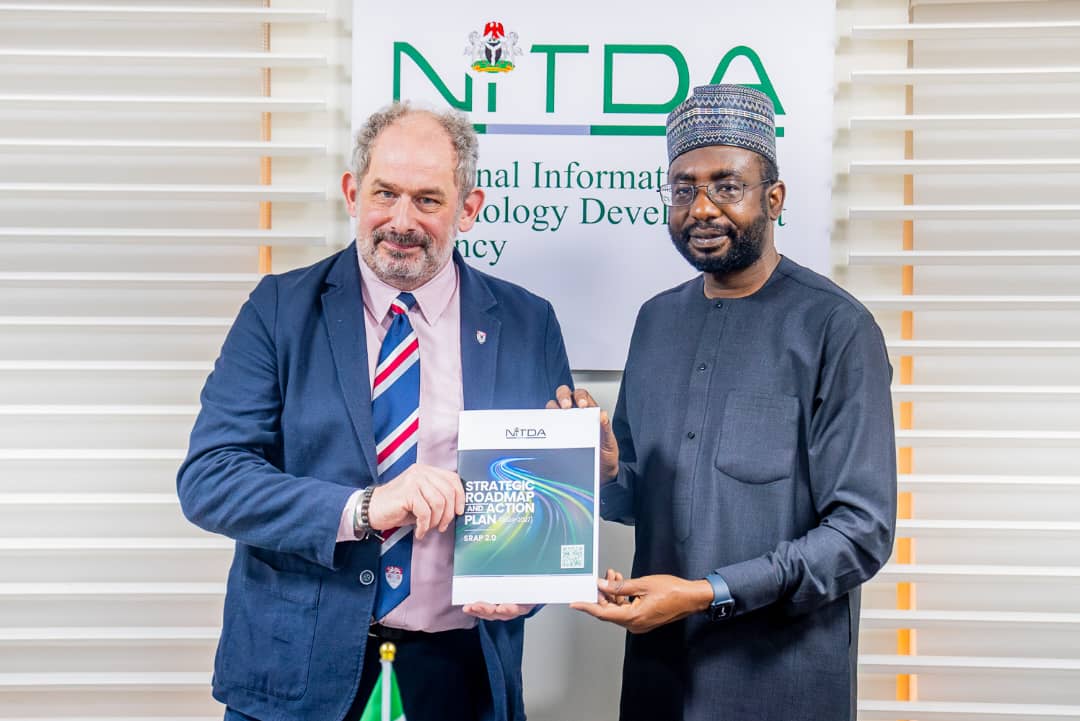
NITDA, Lancaster University Partner to Boost Research-Led Innovation in Nigeria
In a renewed push to drive innovation, youth empowerment, and sustainable national growth, the Director General of the National Information Technology Development Agency (NITDA), Kashifu Inuwa, CCIE, has stressed the urgent need for robust collaboration between academia, industry, and government.
He made the call during a strategic meeting with a delegation from Lancaster University, United Kingdom, led by Professor Kirk Semple, Director of International Research, at NITDA’s corporate headquarters in Abuja.
The meeting centred on deepening ties under the Research and Innovation Partnership for Entrepreneurship (RIPE) programme — an initiative designed to leverage academic research for entrepreneurial development and economic transformation.
Highlighting the critical role of research in national development, Inuwa lamented the significant investment gap in research across Nigeria and Africa at large. “For us to build a robust and sustainable economy, we need to invest in research. That is where we have a huge gap in Nigeria and Africa at large, we don’t invest in research,” he stated.
He cited agriculture as a sector in dire need of innovation, pointing out that most farmers lack access to digital tools and data that could improve productivity and resource use. Inuwa maintained that research and development (R&D) are key to solving such challenges and formulating policies that drive digital transformation.
The NITDA boss also outlined the agency’s focus on emerging technologies such as Artificial Intelligence (AI), Internet of Things (IoT), blockchain, robotics, and unmanned aerial vehicles (UAVs), all of which he said are capable of addressing local problems and generating economic opportunities.
“Our goal is to create a vibrant technology-research ecosystem that brings together academia, industry, government, entrepreneurs, and risk capital,” Inuwa added.
He called on Nigerian universities to align their curricula with industry needs, develop practical talent, and avoid fragmented efforts by working collaboratively. Inuwa also highlighted the Federal Government’s eight-point development agenda, including economic reform, food security, infrastructure, education, and innovation.
In support of this, he referenced NITDA’s Strategic Roadmap and Action Plan 2024–2027 (SRAP 2.0), which is anchored on eight pillars, including fostering digital literacy, strengthening research, improving cybersecurity, and nurturing innovation through strategic partnerships.
“We place a strong emphasis on research because without it, you can’t develop effective policies or regulations that drive real change,” he said.
In his remarks, Professor Kirk Semple emphasized Lancaster University’s global research reputation and its commitment to collaborations that deliver real-world value. He described the RIPE programme as a platform to move academic insights into practical applications.
“Universities today are under pressure to demonstrate value beyond knowledge creation. Strategic partnerships like this with NITDA help ensure research-informed policy, support innovation, and drive meaningful change in communities,” Semple noted.
He also stressed the importance of building long-term networks that bridge academia and society, especially in addressing global challenges such as climate change, health, and technology access.
The meeting marked a significant milestone in NITDA’s international collaboration efforts, aligning with President Tinubu’s Renewed Hope Agenda and reinforcing Nigeria’s ambition to lead in the global digital economy through research-led innovation.