

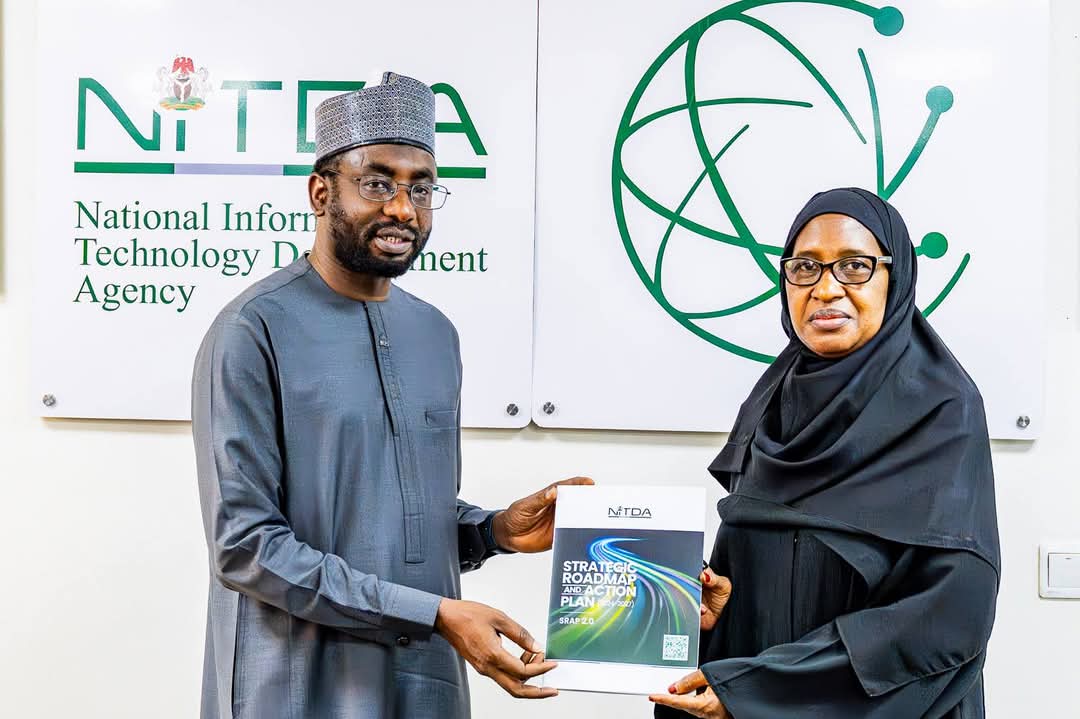
NITDA, NSUK Strengthen Partnership to Drive Innovation, Digital Literacy
The National Information Technology Development Agency (NITDA) has reaffirmed its commitment to fostering collaboration among researchers, technology experts, and academics to tackle national challenges through innovation and emerging technologies.
The Director General of NITDA, Kashifu Inuwa CCIE, made this known during a visit by the management of Nasarawa State University, Keffi (NSUK), led by Vice Chancellor Professor Sa’adatu Hassan Liman, to the agency’s corporate headquarters in Abuja.
Inuwa emphasized the importance of stronger collaboration between academics, engineers, and entrepreneurs to address pressing national issues such as environmental sustainability, public health, and infrastructure. He noted that this aligns with NITDA’s mission to build a robust technology research ecosystem focused on Digital Literacy, Artificial Intelligence (AI), and Research & Development (R&D). This, he added, also supports President Bola Ahmed Tinubu’s Renewed Hope Agenda, which prioritizes digital transformation and equipping students with future-ready skills.
To institutionalize this collaboration, NITDA and NSUK have agreed to develop a Memorandum of Understanding (MoU) that will drive impactful initiatives and ensure sustainable, long-term engagement between the two organizations. The partnership is expected to accelerate innovation in Nigeria’s tech sector, empower students with digital skills, and contribute to national development through research-driven solutions.
Speaking on the transformative potential of AI, Inuwa highlighted its impact beyond office automation, particularly in healthcare and agriculture.
“Imagine developing a bot that can provide quality health services to our remote areas. One of the challenges we are facing in our healthcare system is the lack of professionals. It’s difficult to get specialist doctors everywhere, but AI can help fill this gap,” he stated.
He referenced a recent research study in Nigeria where AI-powered chatbots, such as ChatGPT, were tested against human doctors in providing medical prescriptions. The results showed that AI-generated prescriptions were often comparable to, and in some cases, even better than those provided by human doctors.
“This underscores the potential of AI in telemedicine, offering accessible and efficient healthcare services to underserved communities. Beyond healthcare, NITDA believes AI can drive innovations in agriculture, education, and other critical sectors, reinforcing the agency’s commitment to leveraging technology for national development,” Inuwa added.
In her remarks, Professor Sa’adatu Hassan Liman expressed appreciation to NITDA for its continued support in strengthening technology research, digital literacy, and innovation at NSUK. She highlighted the university’s role as a pioneer participant in NITDA’s digital transformation program, a model that the National Universities Commission (NUC) is now working to extend to other universities across Nigeria.
“The university believes the initiative will be a huge success, aligning with its vision of equipping students with digital skills to meet global workforce demands,” she stated.
As part of its commitment to advancing technology education, NSUK has established a Digital Literacy Center at its Faculty of Engineering, where students are working on developing tech gadgets to enhance their skills and competitiveness globally.
“Our goal is to ensure that our students are not only well-prepared for Nigeria but also globally competitive wherever they go,” Professor Liman emphasized.
She further noted that the collaboration between NITDA and NSUK continues to strengthen Nigeria’s technology and innovation ecosystem, ensuring that students are adequately prepared for the digital economy and future workforce.
The partnership is expected to pave the way for groundbreaking research, digital innovation, and a new era of technology-driven national development.












 has reaffirmed its commitment to fostering collaboration)