What Nigeria’s ‘Cyber for Women’ Says About the Global Cybersecurity by Shuaib S. Agaka
Across continents, industries are grappling with a defining paradox of the digital age. Cyber threats are becoming more complex and frequent, yet the global workforce responsible for defending systems, data, and infrastructure remains dangerously thin. At the same time, women, who represent a vast and largely untapped talent pool, continue to be underrepresented in cybersecurity roles. This convergence of a skills shortage and a gender gap is no longer a distant concern. It is an immediate challenge as economies digitise faster than their capacity to secure themselves.
Recent estimates from ISC2 show that the global cybersecurity workforce gap still runs into millions. Its latest workforce study suggests the industry requires more than four million additional professionals to adequately protect digital ecosystems. While the number of practitioners has grown, it has not kept pace with the expanding attack surface driven by cloud adoption, artificial intelligence, and connected devices. Emerging economies face the sharpest edge of this imbalance because digital transformation is accelerating without equivalent investment in human capital.
Within this shortage lies a deeper structural issue. Women account for roughly a quarter of the global cybersecurity workforce, with most estimates ranging between 24 and 26 percent. For years, there has been a push to move beyond the 30 percent threshold, yet progress has been slow. The reasons are not rooted in ability but in access, exposure, and long-standing perceptions about who belongs in technology fields. These barriers often begin early, shaping educational choices and career trajectories long before individuals enter the workforce.
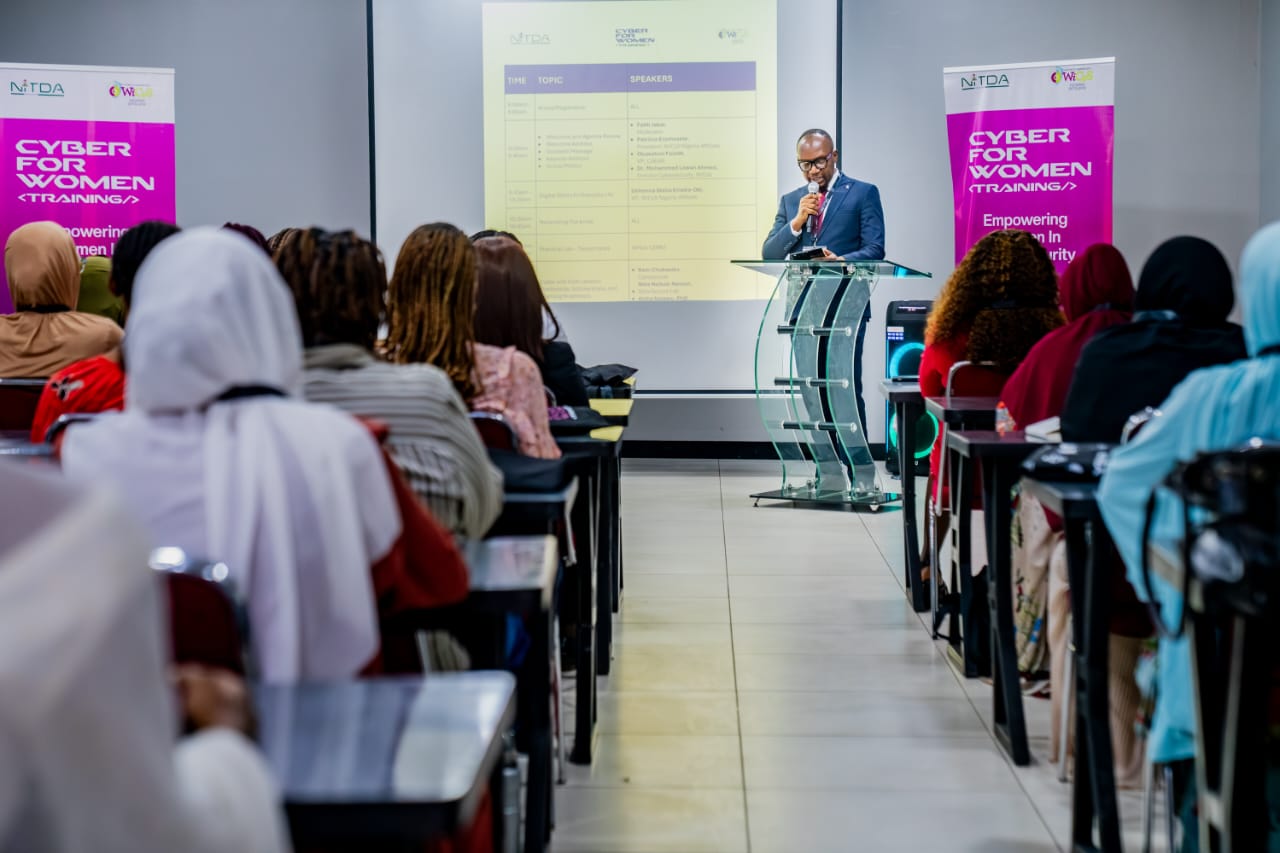
It is against this backdrop that Nigeria’s “Cyber for Women” programme, launched in Abuja by the National Information Technology Development Agency in collaboration with Women in Cybersecurity, takes on broader significance. Rather than a routine training initiative, it represents a targeted response to two intertwined global challenges, expanding the cybersecurity talent pool while addressing gender imbalance within it.
The urgency of this effort becomes clearer when viewed through the lens of global risk. Projections from institutions such as the World Economic Forum estimate that cybercrime could cost the global economy more than ten trillion dollars annually within a few years. Beyond financial loss, this reflects a growing erosion of trust in digital systems. For developing economies, where digital platforms underpin financial inclusion and public service delivery, weak cybersecurity capacity can undermine hard-won progress.
Nigeria illustrates this tension. As one of Africa’s largest digital markets, it has experienced rapid growth in fintech, e-government services, and online commerce. This expansion has created new opportunities but also increased exposure to cyber risks, from fraud to data breaches and infrastructure attacks. The shortage of skilled professionals means that threats are often met with limited defensive capacity, creating vulnerabilities that extend beyond national borders.
When local expertise is insufficient, countries tend to rely on external support, which can be costly and sometimes disconnected from domestic realities. This reliance can slow response times, weaken regulatory enforcement, and limit proactive threat detection. In a globally connected digital environment, such gaps do not remain isolated. They contribute to systemic weaknesses that can be exploited across regions.
The gender divide further complicates this picture, particularly in Africa, where representation is often lower than global averages. Cultural expectations continue to shape how girls engage with science and technology. Many are discouraged, subtly or directly, from pursuing technical paths, leading to fewer women entering ICT disciplines at higher education levels. Even among those who do, specialisation in areas like cybersecurity remains limited.
Access also plays a critical role. In many communities, digital resources such as computers and reliable internet are unevenly distributed. Where these resources are scarce, boys are more likely to receive priority, reinforcing early disparities. By the time career decisions are made, the gap has already widened significantly.
Professional environments introduce another layer of difficulty. Women in tech frequently encounter bias, limited mentorship, and slower advancement. In cybersecurity, where continuous learning is essential and roles can be demanding, these challenges contribute to higher dropout rates. The result is a self-reinforcing cycle in which low representation discourages new entrants, sustaining the imbalance.
The Abuja initiative seeks to disrupt this cycle by addressing multiple barriers at once. Through the “Cyber for Women” programme, participants gain practical skills in areas such as threat analysis, risk management, and incident response. Equally important is the emphasis on collaboration and mentorship, creating a support network that extends beyond the training itself. This combination reflects an understanding that closing the gender gap requires more than technical instruction.
Partnership with Women in Cybersecurity adds another dimension. By linking local participants to a global network, the programme connects Nigerian women to mentorship opportunities, industry insights, and career pathways that might otherwise be out of reach. This integration with an established ecosystem increases the likelihood of long-term impact.
The broader significance of such programmes lies in their dual effect. They advance digital inclusion at the national level while strengthening global cybersecurity resilience. Cyber threats are inherently transnational. A weakness in one country can be leveraged to launch attacks elsewhere, making capacity building a shared responsibility. Expanding the talent pool through greater inclusion is therefore both a local and global imperative.
Diversity itself has practical advantages. Teams with varied perspectives are often better at identifying vulnerabilities and responding to complex threats. In an environment where adversaries constantly adapt, this diversity can enhance defensive strategies and reduce blind spots.
Globally, similar efforts are underway, though with mixed results. Governments and organisations in North America, Europe, and Asia have introduced scholarships, training programmes, and policy incentives to attract women into cybersecurity. Some countries have integrated cybersecurity education into school curricula to address the pipeline issue early. However, many initiatives struggle with continuity, funding, and the transition from training to employment.
This underscores a key lesson. Training must be part of a broader framework that includes industry partnerships, clear career pathways, and ongoing professional development. Without these elements, gains made at the entry level may not translate into sustained participation.
For Nigeria, the success of “Cyber for Women” will depend on how it evolves beyond its launch. Scaling the programme, tracking outcomes, and aligning it with industry needs will be critical. Engagement with the private sector will determine whether participants can transition into meaningful roles within the cybersecurity ecosystem.
Looking ahead, the pressures driving both the skills shortage and the gender gap are unlikely to ease. As technologies such as artificial intelligence and the Internet of Things expand, the demand for cybersecurity expertise will intensify. At the same time, organisations will face increasing expectations to demonstrate inclusivity, not only as a social goal but as a strategic necessity.
Education systems will also need to adapt, introducing cybersecurity concepts earlier and ensuring equal access for girls. Addressing the pipeline issue is essential for long-term change. International collaboration will play a growing role as well, enabling knowledge sharing and resource pooling across borders.
The intersection of the cybersecurity skills crisis and the gender divide reveals a challenge that cannot be solved in isolation. Nigeria’s initiative offers a glimpse of what a more integrated response can look like. By investing in women as part of its cybersecurity strategy, the country is not only addressing a domestic gap but contributing to a global solution. Sustaining and expanding such efforts will be key to building a more secure and inclusive digital future.
Shuaib S. Agaka is a tech journalist and digital policy analyst based in Kano.