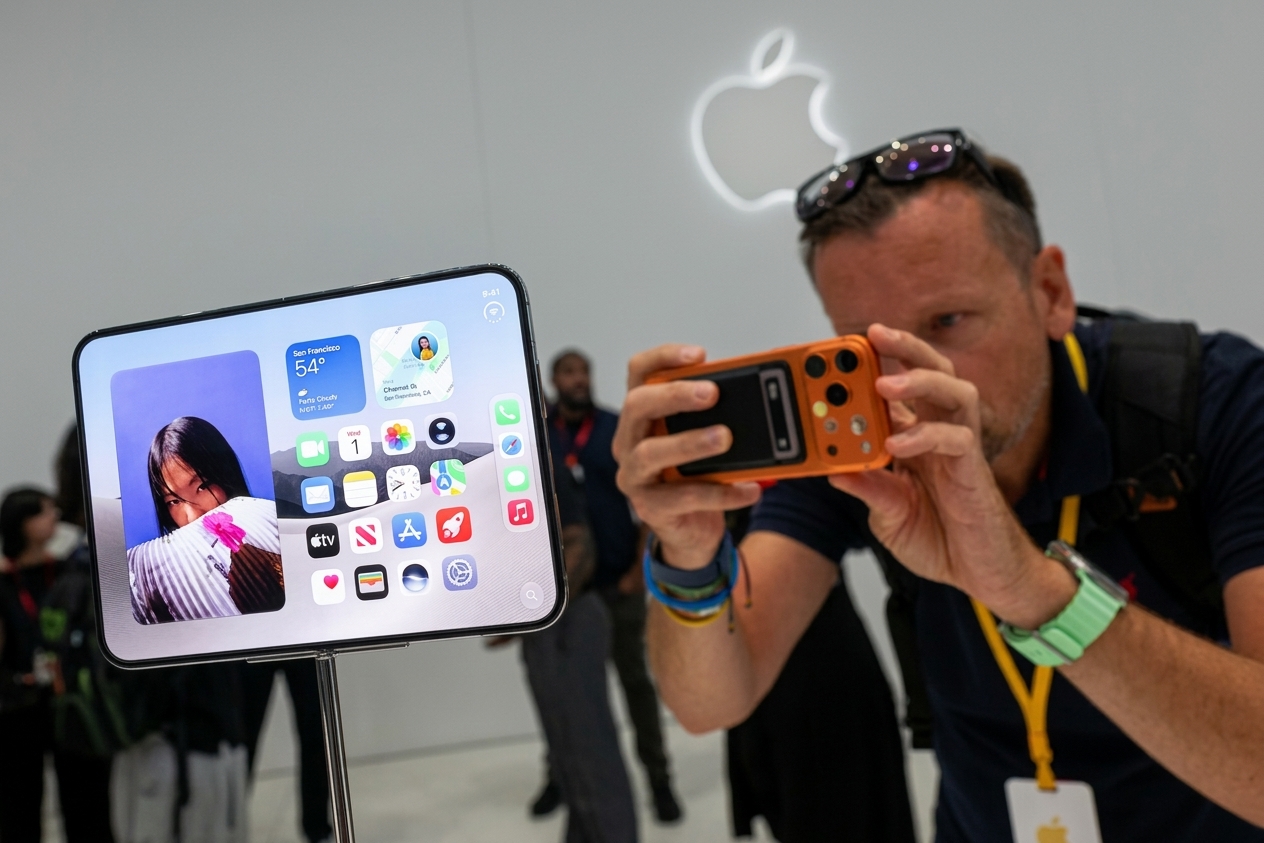
FOLD ABLE SMARTPHONES: Unveiling iPhone Duo and Samsung Galaxy Z
By Tahir Ahmad
Apple has finally entered the foldable smartphone market, reigniting one of the most entertaining rivalries in consumer technology.
The company’s first foldable iPhone, the iPhone Duo, has attracted considerable attention from smartphone enthusiasts who have long watched Samsung develop its Galaxy Z Fold series. With a book-style design, a large internal display and a premium price tag, the Duo appears ready to challenge Samsung’s latest offering, the Galaxy Z Fold8.
However, Apple’s arrival raises an important question: has the company introduced a genuinely different foldable experience, or has it simply refined a design Samsung has spent years developing?
Both phones follow the book-style foldable design. When closed, they function as conventional smartphones. When opened, they reveal a larger screen suitable for reading, watching videos, multitasking and productivity.
The iPhone Duo features a 5.4-inch external display and a 7.6-inch internal screen. Samsung’s Galaxy Z Fold8 has a slightly larger 5.5-inch external display and a 7.6-inch internal screen. Both internal displays support a 120Hz refresh rate and offer peak brightness of up to 3,000 nits.
The similarities, however, end quickly.
Apple has equipped the Duo with a nano-textured, anti-reflective display designed to reduce glare and make the crease less noticeable. Samsung uses a glossy display with anti-reflective treatment. Early impressions suggest that Apple’s crease is particularly difficult to see, although long-term testing will be necessary to determine whether this advantage survives months of use.
Apple has also introduced Apple Pencil support, giving the Duo an advantage for users interested in handwriting, sketching and digital note-taking. The Galaxy Z Fold8, in contrast, does not support Samsung’s S Pen.
The differences between the two devices become clearer when their specifications are considered in detail. The iPhone Duo is powered by Apple’s A20 Pro chip, while Samsung’s Galaxy Z Fold8 uses Qualcomm’s Snapdragon 8 Elite Gen 5 processor. Both processors are designed to handle demanding applications, gaming and multitasking, although real-world performance will depend on software optimisation and independent testing.
In terms of cameras, the iPhone Duo reportedly features a 48MP main camera and a 48MP ultra-wide camera. The Galaxy Z Fold8 offers a 50MP main camera alongside an ultra-wide camera. Although Samsung’s main camera has a higher megapixel count, that does not automatically make it superior. Image processing, sensor quality, stabilisation and software also influence the quality of photographs and videos.
Apple’s experience with computational photography, video processing and colour management could make the Duo a strong competitor for content creators. Samsung, however, has an established reputation for versatile camera systems and advanced video capabilities.
The two phones also differ in their physical dimensions. The iPhone Duo weighs 254g, while the Galaxy Z Fold8 weighs 201g, making Samsung’s device considerably lighter. The Galaxy Z Fold8 is approximately 8.9mm thick when folded, compared with the Duo’s reported 11.3mm. These differences could matter to users who carry their phones throughout the day.
The iPhone Duo reportedly supports up to 2TB of storage, while the Galaxy Z Fold8 offers up to 1TB. For users who regularly record high-resolution videos, store large files or use their phones for professional work, the additional storage on Apple’s device could be attractive.
Battery capacity and charging are also important considerations. Samsung’s Galaxy Z Fold8 has a reported 4,800mAh battery and supports wired charging of up to 45W. Apple’s battery capacity has not been publicly confirmed, although the company’s power-management technology could influence the Duo’s battery performance. The iPhone also supports MagSafe and wired charging.
Durability is another important consideration. Apple gives the Duo an IP68 rating, while the Galaxy Z Fold8 carries an IP48 rating. The difference suggests that the iPhone has stronger protection against dust and water, although neither rating makes a foldable immune to damage. The durability of the hinges, flexible displays and folding mechanisms will ultimately require extensive real-world testing.
The iPhone Duo starts at $1,999, while the Galaxy Z Fold8 starts at $1,899 in the United States. This gives Apple’s first foldable a $100 premium over Samsung’s latest model.
That difference may appear modest within the luxury smartphone market, but the final cost could be considerably higher in countries such as Nigeria, where exchange-rate movements, import duties, shipping costs, retailer margins and taxes influence smartphone prices.
For Nigerian consumers, the price difference could become more significant if the naira weakens against the dollar or if import-related costs increase. A phone priced at $1,999 could therefore become considerably more expensive locally than its advertised US price. Buyers may also have to consider the cost of repairs, replacement parts and specialist servicing, which can be more expensive for foldable devices.
Apple’s premium could also increase demand for older iPhone models, particularly if consumers who prefer the company’s ecosystem decide to upgrade. Samsung, on the other hand, may respond with discounts, trade-in offers or promotional bundles to retain customers.
The larger question is whether consumers will pay more for Apple’s first-generation foldable when Samsung already offers an eighth-generation alternative.
Apple’s announcement has also reignited the familiar rivalry between iPhone and Samsung enthusiasts. Technology commentators and creators, including Marques Brownlee, Zack Nelson of JerryRigEverything and Parker Burton, have become part of the wider conversation surrounding foldable phones. Their reviews, comparisons and technical discussions help audiences examine the devices beyond marketing claims.
Brownlee’s long-standing influence in smartphone reviews, Nelson’s reputation for durability testing and the broader online technology community have made foldable-phone comparisons especially popular.
Social media has added another dimension to the rivalry. Samsung supporters have questioned whether Apple’s entry represents genuine innovation, while Apple supporters argue that the company has taken time to refine the technology before entering the market.
Samsung has also joined the conversation by mocking Apple’s foldable phone on social media, accusing the company of recycling an idea that Samsung had already developed. The exchange illustrates how smartphone competition has become more than a contest over specifications; it is also a battle over brand loyalty, identity and technological leadership.
The iPhone Duo brings Apple’s ecosystem, a new processor, Apple Pencil compatibility, a reportedly subtle crease and stronger water and dust resistance. It could appeal to users who want a foldable phone that doubles as a tablet while remaining integrated with their existing Apple devices.
The Galaxy Z Fold8 offers a lighter body, a lower starting price, a mature foldable design and Android’s flexibility. Samsung’s experience could also make it a safer choice for consumers concerned about the risks associated with a first-generation product.
Ultimately, the better phone depends on what the user values most. Apple’s premium may be justified for those who prioritise its ecosystem and software experience. Samsung may offer better value for users who want a refined foldable without paying the additional cost of Apple’s debut.
As the iPhone Duo prepares to enter the market, which phone would you choose: Apple’s first foldable iPhone Duo or Samsung’s Galaxy Z Fold8—and what would ultimately influence your decision?
Tahir Ahmad is a journalist, author of Anti-Drug, Anti-Smuggling Campaigns: A Corper’s Chronicle, and a fellow of PRNigeria. He writes from Abuja and can be reached via [email protected].