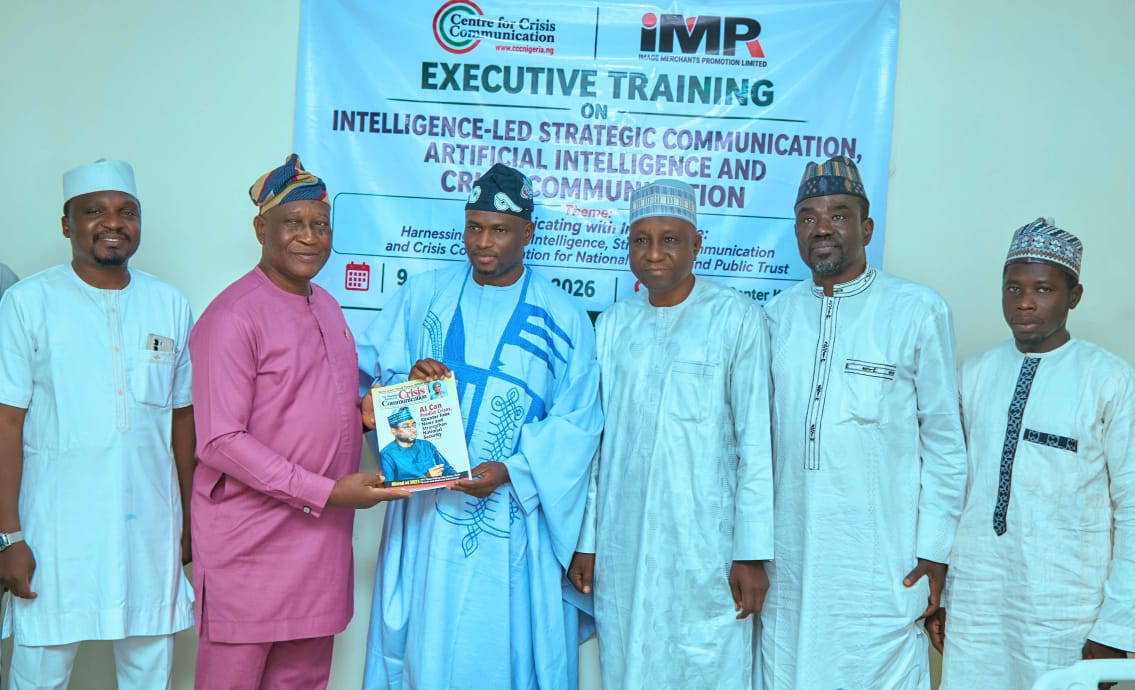
The newly appointed Kano State Commissioner for Information and Internal Affairs, Sanusi Bature Dawakin Tofa, has undertaken his first official assignment by declaring open an executive capacity-building programme on artificial intelligence (AI), strategic communication and crisis management, as the Centre for Crisis Communication (CCC) announced plans to activate a national Crisis Communication Hub on December 1, 2026.
The training, held at the PRNigeria Centre in Kano, brought together communication professionals from security agencies, government establishments and regulatory institutions to strengthen their capacity in information management, emerging technologies, crisis response and public engagement.
Organised by the CCC in partnership with Image Merchants Promotion Limited (IMPR), publishers of PRNigeria and Economic Confidential, the programme was themed “Communicating with Intelligence: Harnessing Artificial Intelligence, Strategic Communication and Crisis Communication for National Security and Public Trust.”
In his welcome address, Shuaib congratulated Bature on his appointment, describing his elevation as recognition of years of professional commitment to journalism, public relations and government communication.
He traced the commissioner’s career progression from Press Secretary to Director-General of Media and Public Relations, and subsequently to Commissioner for Information and Internal Affairs, while retaining his responsibility as Special Spokesperson to Governor Abba Kabir Yusuf.
Shuaib said the appointment deserved celebration and prayers for wisdom, guidance and personal safety, particularly given the complexities of Nigeria’s contemporary political environment.
Having known Bature for more than a decade as a journalist, social worker and mentor to younger communication professionals, Shuaib expressed confidence that his experience would be valuable in his new assignment.
He, however, reminded the commissioner that his responsibilities had expanded beyond communicating the policies and activities of the governor and the state government.
According to him, the office of Commissioner for Information carries a broader obligation to communicate in the interest of all Kano residents, regardless of their political affiliations, religious beliefs or ideological differences.
Shuaib urged Bature to approach his new responsibilities with fairness, professionalism and inclusiveness, stressing that government communication should strengthen public confidence and promote social cohesion rather than deepen political divisions.
He also commended the commissioner’s previous contributions to professional development and public relations initiatives, describing his participation in the training as particularly significant at a time when institutions were confronting the challenges of misinformation, technological disruption and declining public trust.
In his remarks, the Chairman of the Centre for Crisis Communication, Major General Chris Olukolade (rtd), raised concerns over the increasing circulation of fake news, hate speech, manipulated videos and AI-generated disinformation, particularly as political activities intensify ahead of the 2027 general elections.
Olukolade disclosed that the proposed Crisis Communication Hub (CCH) would be formally activated on December 1, 2026, to strengthen the detection, assessment and coordinated response to harmful information capable of threatening national security and peaceful coexistence.
He explained that the initiative was designed to identify emerging misinformation and disinformation trends, provide timely public advisories and support relevant regulatory authorities with assessments requiring appropriate institutional attention.
According to him, the hub would be particularly concerned with digital content capable of inciting electoral violence, aggravating ethnic and religious tensions or undermining public confidence in democratic institutions.
The CCC chairman said the initiative, being developed in partnership with the National Information Technology Development Agency (NITDA), would involve representatives of security institutions, media organisations and non-governmental organisations.
He explained that the multi-stakeholder composition was intended to promote balanced assessments, professional judgement and fairness in the handling of potentially harmful information.
Olukolade stressed the importance of distinguishing legitimate public expression from deliberately manipulated or misleading content, noting that responsible crisis communication required accuracy, coordination and sensitivity to citizens’ rights.
He said the training was therefore designed to equip participants with practical competencies in AI-assisted communication, information verification, crisis preparedness, stakeholder engagement and institutional response.
Delivering the keynote address, the Chairman of the Board of IMPR and Professor of Strategic Communication, Sule Ya’u Sule, described artificial intelligence as an increasingly important tool for improving professional productivity, information accessibility and communication effectiveness.
He explained that AI could assist practitioners in researching complex subjects, analysing emerging developments, preparing communication strategies, drafting institutional messages and verifying information circulating across digital platforms.
However, Sule warned against accepting AI-generated content without independent verification, stressing that the technology could also be exploited to fabricate events, manipulate public perceptions and spread dangerous falsehoods.
Citing a video reportedly generated with artificial intelligence following the collapse of the Nasarawa Bridge, he warned that misleading digital content could trigger unnecessary public anxiety, distort institutional responses and create security complications.
“One mistake can ignite trouble in the country,” he cautioned.
The professor emphasised that the consequences of misinformation could be particularly serious during emergencies, security operations and politically sensitive periods when inaccurate information might provoke panic, hostility or violence.
He urged participants to develop practical competence in using AI tools while recognising their limitations, including the risks of fabricated information, algorithmic errors and overdependence on automated outputs.
According to him, effective communication professionals must combine technological proficiency with human judgement, ethical responsibility and rigorous fact-checking.
Sule encouraged participants to explore AI-assisted communication strategies, improve organisational messaging, verify social media claims and integrate emerging technologies into crisis management procedures.
He stressed that artificial intelligence should support professional decision-making rather than replace critical thinking, human oversight or accountability.
The keynote speaker also called for similar capacity-building programmes for political actors, campaign organisations and institutional spokespersons ahead of the 2027 general elections.
He maintained that equipping political communicators with the skills to identify manipulated content, verify claims and communicate responsibly would help reduce the risks of misinformation, hate speech and inflammatory political messaging.
Sule further urged public relations practitioners to remain alert, open-minded and proactive in gathering information, analysing emerging situations and developing practical solutions to institutional and societal challenges.
Speaking at the opening ceremony as Special Guest of Honour, Bature stressed that effective public relations practitioners must be problem-solvers capable of managing institutional challenges, resolving conflicts and maintaining public confidence.
He said communication professionals were frequently required to address organisational crises, even when they had no role in creating the underlying problems.
“Most of the time, we are not the people who create the problems within our organisations. Rather, we are the people expected to solve them,” the commissioner stated.
According to him, the growing complexity of public communication demands continuous professional development, technological competence and a willingness to adapt to emerging realities.
“Whoever is not exposed to trainings like this will soon be not only outdated but a problem to communication,” he warned.
Bature maintained that Nigeria needed leaders and institutional spokespersons who could communicate intelligently, understand complex situations and provide practical solutions rather than merely issue statements.
He emphasised that effective strategic communication required sound judgement, professional competence, stakeholder engagement and the ability to respond appropriately to emerging challenges.
The commissioner also reflected on his professional journey, acknowledging the contributions of experienced communication practitioners who had supported his development over the years.
He particularly commended Professor Sule Ya’u Sule and the Managing Director of IMPR, Malam Yushau Shuaib, describing them as invaluable professional assets whose mentorship and encouragement had contributed significantly to his career progression.
Bature said their support predated his appointment as spokesperson to the Kano State Government and continued as he assumed greater leadership responsibilities.
He described both professionals as a form of “social insurance,” providing encouragement, guidance and support behind the scenes throughout his career.
The training forms part of the continuing efforts of the Centre for Crisis Communication and Image Merchants Promotion Limited to strengthen professional capacity in strategic communication, responsible technology adoption and crisis preparedness.
With the planned activation of the Crisis Communication Hub on December 1, the organisers hope to complement their capacity-building initiatives with a coordinated mechanism for monitoring digital information threats, supporting timely crisis response and strengthening public trust as Nigeria approaches another election cycle.