

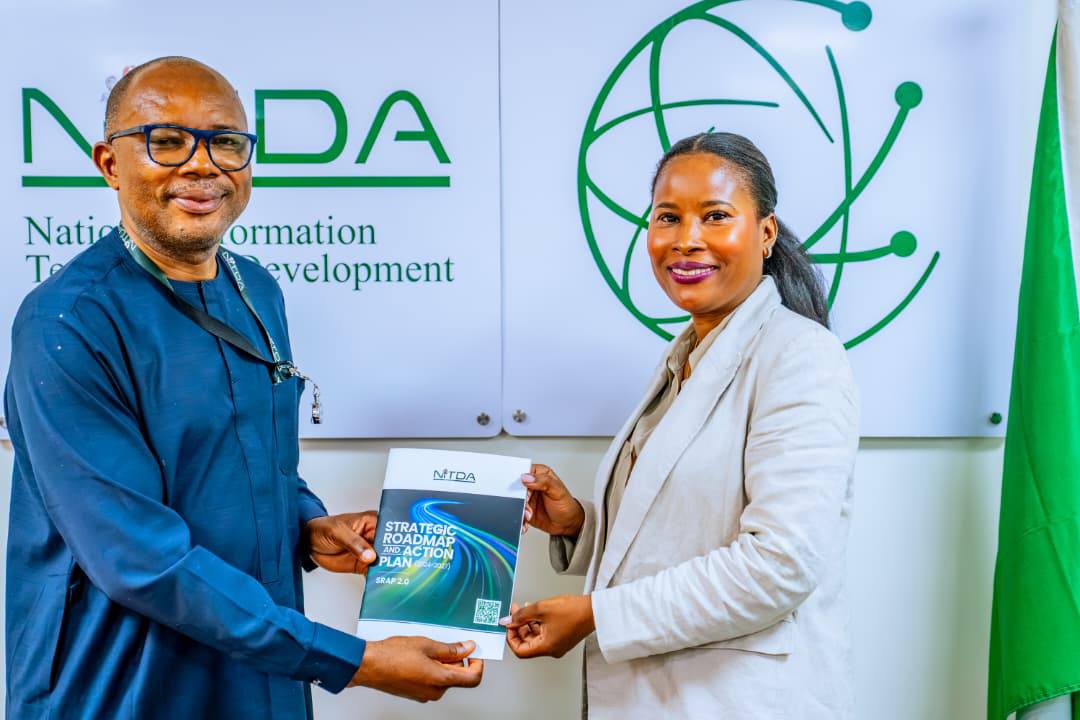
NITDA, Benin’s Digital Agency Deepen Partnership on Digital Transformation
The National Information Technology Development Agency (NITDA) and the Republic of Benin’s Information Systems and Digital Agency (ASIN) have reaffirmed their commitment to strengthening bilateral cooperation in digital transformation, digital public infrastructure, and innovation-driven governance.
The renewed partnership was reinforced during a courtesy visit by the Beninese delegation to NITDA’s headquarters in Abuja, where both agencies explored opportunities for deeper collaboration, exchange of best practices, and accelerated digital development across the region.
Speaking during the meeting, NITDA Director-General, Kashifu Inuwa, represented by the Director of Stakeholder Management and Partnerships, Dr. Aristotle Onumo, stressed the importance of regional cooperation in building Africa’s digital economy and resilient digital ecosystems capable of driving sustainable growth.
He explained that NITDA remains committed to advancing Nigeria’s digital transformation agenda through the formulation of policies, standards, and strategic frameworks aimed at modernising governance and enhancing public service delivery.
According to him, the agency has developed several key frameworks, including the Enterprise Governance Framework, Digital Transformation Framework, and Software Quality Assurance Framework, to support Ministries, Departments, and Agencies (MDAs) in their digital transformation efforts.
“Our objective is to move government institutions beyond basic digitalisation towards full digital transformation and ultimately establish an intelligent, data-driven government powered by emerging technologies such as artificial intelligence,” he stated.
Inuwa further disclosed that since 2018, NITDA has reviewed government IT projects valued at over ₦1.5 trillion to ensure compliance, technical alignment, and value for money.
He noted that the initiative has enabled the Federal Government to save more than ₦300 billion by reducing duplication, encouraging shared services, and improving the implementation success rate of digital projects across MDAs.
On digital public infrastructure, he revealed that Nigeria has transitioned from fragmented agency-to-agency data exchanges to a more integrated and citizen-focused digital ecosystem through the Nigerian Data Exchange (NGDX) platform.
He explained that the platform offers a federated and centralised framework that enables seamless data sharing among government institutions while preserving the independence of individual systems.
According to him, the proposed e-Government and Digital Economy Bill will provide the legal framework necessary to strengthen the platform and institutionalize digital collaboration across government institutions.
The NITDA boss also highlighted the agency’s Strategic Roadmap and Action Plan (SRAP 2.0) 2024–2027, which aligns with the Federal Government’s Renewed Hope Agenda and prioritises digital literacy, research and development, cybersecurity, innovation, inclusive access, and strategic partnerships.
Earlier, ASIN’s Head of International Partnerships, Tildy Erlong, said the delegation’s visit followed a recent Smart Africa workshop held in Abuja and was intended to deepen institutional collaboration while learning from Nigeria’s digital transformation journey.
She described ASIN as the implementation agency under Benin Republic’s digital ministry, responsible for executing strategic digital development initiatives in partnership with institutions such as the national identity agency, ANIP, and the cybersecurity agency, CENIN.
Erlong highlighted Benin’s achievements in digital public infrastructure, revealing that nearly 98 per cent of the country’s population—about 13.6 million people—has been enrolled on its digital identity platform.
She added that over 60 government agencies and service institutions are connected through Benin’s XROAD interoperability platform, which currently supports the delivery of more than 250 digital services to citizens.
According to her, Benin is also prioritising digital inclusion, open-source systems, and the application of artificial intelligence to improve service delivery in sectors including healthcare, education, and justice.










 and the Republic of Benin’s Information Systems and Digital Agency (ASIN))