Nigeria at a Crossroads: How AI Is Transforming Crisis Communication
By Fatima Boyi Mahuta
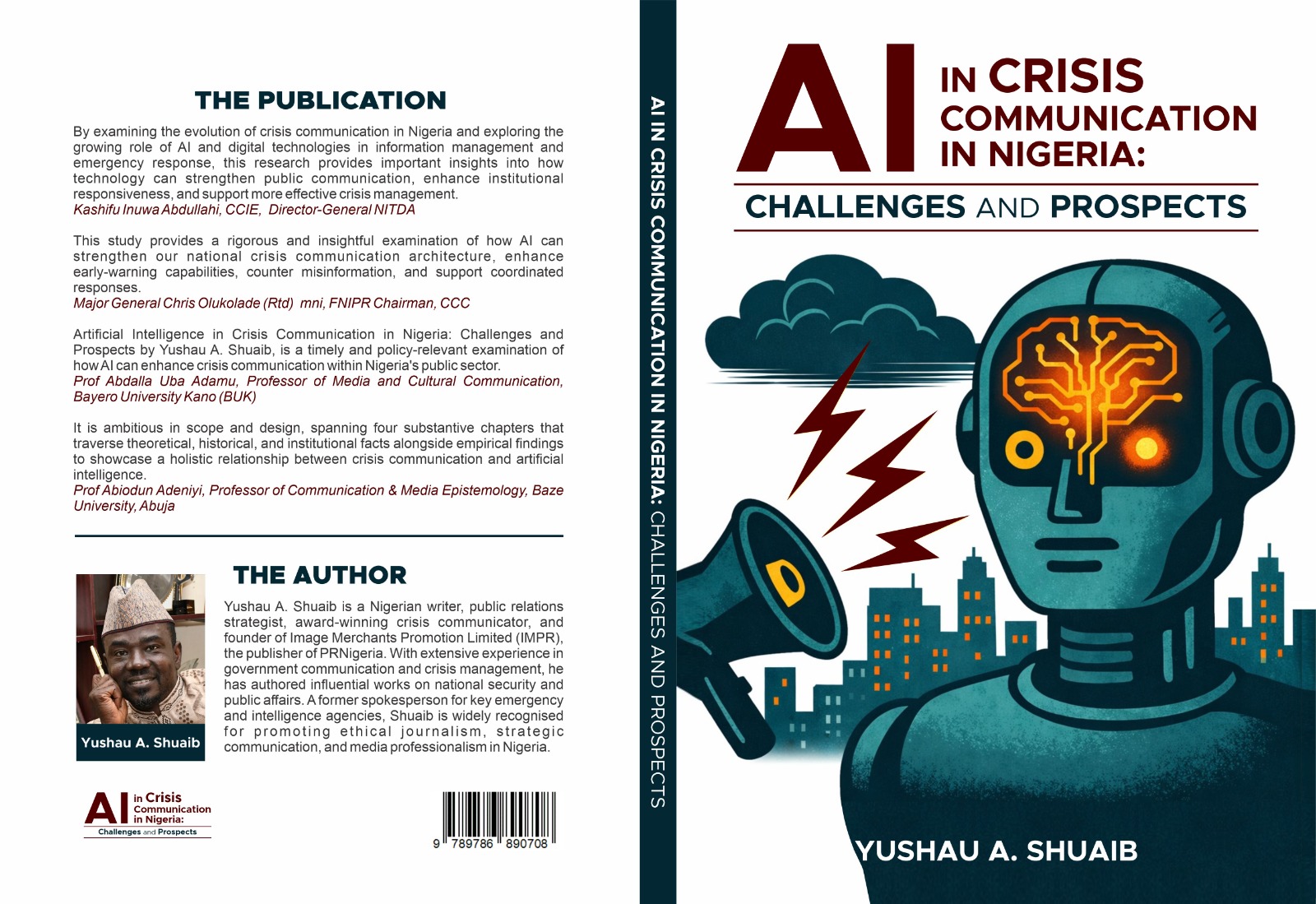
Communication is the backbone of crisis management, and Yushau Shuaib’s AI in Crisis Communication in Nigeria: Challenges and Prospects places this truth at the center of its analysis. The book explores how artificial intelligence is reshaping crisis communication in Nigeria, examining adoption patterns, effectiveness, public trust, implementation barriers, and policy pathways.
In the foreword, Kashifu Inuwa Abdullahi acknowledges a global reality: AI is transforming public service delivery, yet it brings concerns about accountability, information integrity, and the future of human interaction in an increasingly digital world. This tension frames the book’s exploration of how societies—especially developing ones—must adapt technology to their unique social and cultural contexts.
The book draws a clear contrast between developed and developing nations. Countries like Japan integrate AI directly into emergency systems. During the 2011 Tohoku earthquake and tsunami, Japan’s use of AI was effective largely because of high digital literacy, strong public trust, and widespread smartphone ownership. Africa’s experience is more gradual. Kenya leads East Africa in digital crisis response, even deploying an AI chatbot, Zuri, to provide verified health information during outbreaks.
Nigeria has made notable progress too. AI-powered flood early warning systems in states like Kogi and Anambra have saved lives. Yet the digital divide remains a major barrier. With smartphone penetration at only 30–40 percent, compared to Japan’s 83 percent and Kenya’s 91 percent, millions of Nigerians remain excluded from advanced AI tools. Weak internet connectivity and frequent power outages deepen this gap.
One of the book’s strengths is its historical sweep. Crisis communication in Nigeria began with traditional town criers and missionary messaging, evolved into propaganda-heavy tactics—such as the use of images of starving children during the Biafra crisis, a practice now recognized as poverty pornography—and later shifted to institutional frameworks like NEMA and the Centre for Crisis Communication (CCC). Colonial-era communication was one-directional and biased. For years, government agencies and private sectors such as aviation and banking underestimated the importance of crisis communication. Only after repeated crises did they begin embracing public accountability instead of excuses and defensiveness.
Using questionnaires and interviews across public and private institutions, the study found strikingly consistent patterns. Seventy-five percent of respondents were familiar with AI in crisis communication, and most believed their organizations already use AI tools. Public information dissemination is the most common AI application. Social media is the first place people seek crisis updates, followed by radio. AI chatbots—such as ChatGPT—are heavily used when official channels fail. The study also found that AI-generated responses did not reduce public trust, especially when used in rebuild strategies that emphasize accountability.
The study set out to understand how AI supports public-sector crisis communication, how AI-driven information shapes public perception, and how technology can bridge gaps between government and citizens. It successfully addressed these questions with evidence-based insights. Still, legitimate concerns remain. Automated systems may misinterpret cultural or religious nuances. Deepfakes and misinformation pose serious threats. Public reluctance to verify information can escalate tensions. Institutions like the Nigerian Institute of Public Relations (NIPR) are therefore advocating for responsible AI use. AI is here to stay, but it must complement—not replace—human expertise.
The author proposes several actionable steps: building nationwide AI literacy, establishing a national ethical framework for AI, expanding AI integration across agencies, and defining collaborative roles for the Federal Ministry of Information, NEMA, CCC, and security and emergency bodies. These recommendations align with Everett Rogers’ Diffusion of Innovation Theory, which places Nigeria in the innovator and early adopter phases, indicating significant room for growth.
I approached this book expecting dense technical jargon, but Shuaib delivers clarity without oversimplification. The work is accessible, well-structured, and deeply relevant. It is a must-read for anyone seeking to understand how crisis communication operates in Nigeria—and how AI is reshaping it globally.