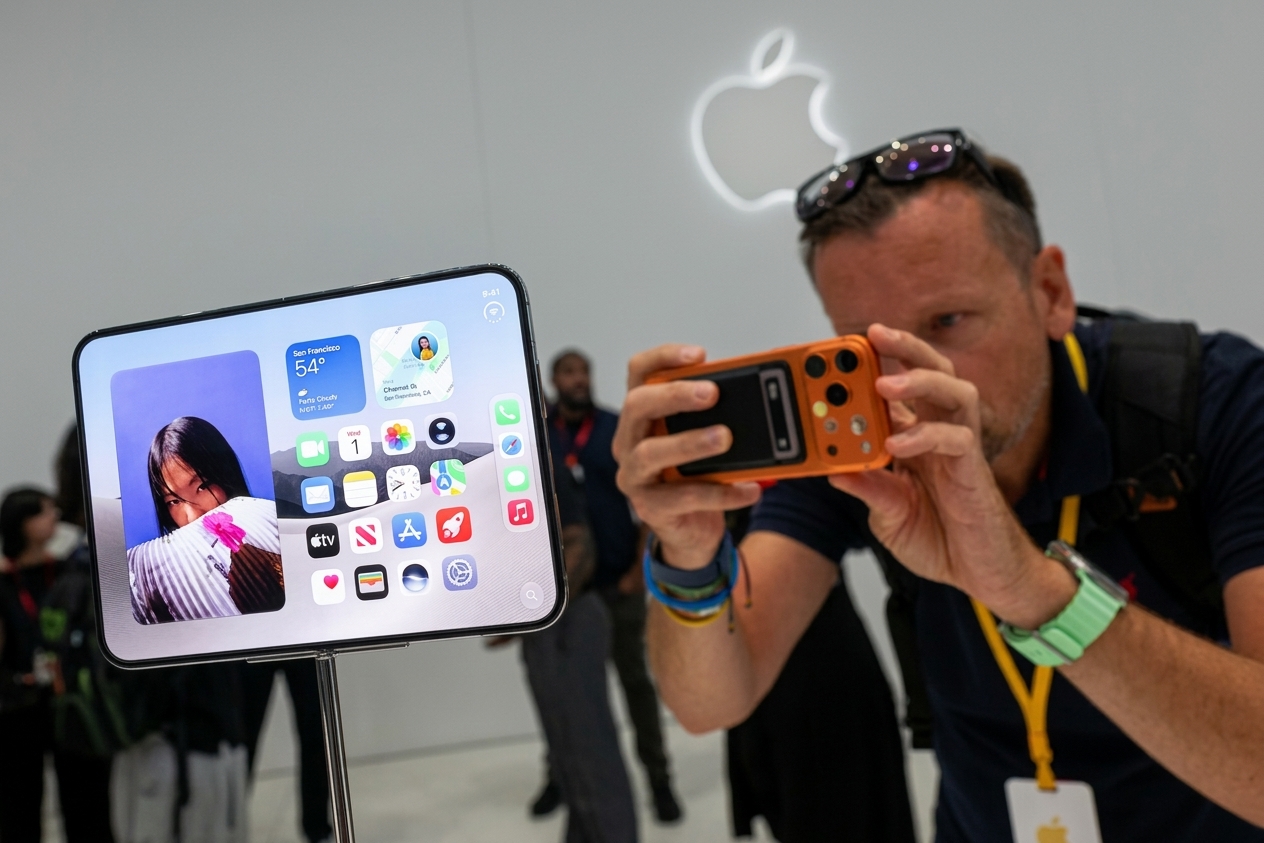
Apple has unveiled its first foldable iPhone, the $1,999 iPhone Duo, marking the company’s most significant redesign of its flagship smartphone in years and opening a new chapter in its competition with Samsung and Huawei.
The device, introduced on Wednesday at Apple’s first major product event under new Chief Executive Officer John Ternus, folds to roughly the size and shape of a passport and opens into a 7.6-inch display that can be used in both horizontal and vertical orientations.
A smaller external screen allows the phone to function normally while folded, while its open configuration gives users a larger workspace. Apple said the Duo is the thinnest iPhone it has produced when fully opened.
The launch represents Apple’s biggest change to the iPhone’s physical design since the company removed the traditional home button with the iPhone X in 2017.
The iPhone remains Apple’s largest source of revenue, generating $209.6 billion, or slightly more than half of the company’s total sales, in its most recent fiscal year.
Apple is positioning the Duo as more than a larger smartphone, highlighting its potential as a productivity device. During the presentation, executives demonstrated the phone handling multi-participant Zoom calls and displaying a wider version of the Slack messaging platform.
The larger screen can also accommodate multiple applications at once, extending a multitasking approach Apple has previously used on its iPad lineup.
Ternus criticised existing foldable phones as awkward and poorly suited to everyday activities such as scrolling and watching videos. He said Apple designed the Duo to deliver an iPad-like experience in a pocket-sized device through a customised hinge, dual displays with a consistent aspect ratio and a new titanium body.
“It’s entirely new and at the same time remarkably familiar,” Ternus said, describing the device as similar in size to a passport and comfortable to use with one hand.
The iPhone Duo will be powered by Apple’s A20 chip and feature the company’s new C2 modem, as Apple continues its effort to reduce reliance on Qualcomm for wireless connectivity components.
Analysts said the foldable could create a new premium segment for Apple and provide fresh momentum for the iPhone business. Apple shares, however, fell 1.8% by the end of the presentation.
Ternus Puts Privacy And AI At Centre Of New iPhone
The launch also marked the formal beginning of Ternus’ tenure as Apple’s chief executive, with outgoing CEO Tim Cook making a brief appearance at the start of the presentation before handing the spotlight to his successor.
Ternus presented the iPhone as a personal artificial intelligence hub built around privacy, contrasting Apple’s approach with technology companies that collect and store large amounts of user data.
He said Apple Intelligence processes information on the device whenever possible, giving users greater control over their personal data.
Apple also demonstrated an updated Siri assistant that the company said would work with about 300,000 applications at launch. Lilian Rincon, who oversees Apple’s iPhone AI products after joining the company from Google earlier this year, led the presentation of the updated assistant.
The company also unveiled the iPhone 18 Pro and iPhone 18 Pro Max, the latest versions of its conventional flagship smartphones.
The iPhone 18 Pro starts at $1,199, while the Pro Max starts at $1,299, representing a $100 increase over the starting prices of their predecessors.
Apple also introduced new technology designed to help users distinguish authentic photographs from AI-generated or manipulated images.
The company’s new “Apple Reference Image” standard is designed to verify images captured with the iPhone 18 Pro camera, while the devices will also support SynthID, an emerging technology for identifying images generated or edited using artificial intelligence.
The Apple Reference Image feature will not be available in the European Union or China.
The iPhone 18 Pro will also feature the A20 Pro chip, with improvements aimed at allowing more advanced AI models to run directly on the device.
AirPods And Apple Watch Get New Features
Apple expanded its hardware lineup with new AirPods and Apple Watch models.
A new AirPods model will start at $129 and introduce noise cancellation to Apple’s lower-priced earbud range. A $149 version will add features including wireless charging and volume controls that allow users to adjust sound by swiping up or down on the stem.
The company also unveiled the Apple Watch Series 12 and Apple Watch Ultra 4, positioning both as significant upgrades focused on health and fitness.
The watches feature redesigned sensor systems capable of collecting heart-rate information more frequently, supporting new tools designed to measure recovery and fitness.
Apple said new silicon and improved sensors make the latest watches its most accurate wearable devices for heart-rate tracking.
$1,999 Price Puts Foldable To The Test
The biggest challenge for Apple may be persuading consumers to pay nearly $2,000 for a smartphone.
Samsung Electronics and Huawei Technologies have sold foldable phones since 2019, but the category has largely remained a niche market dominated by technology enthusiasts.
Apple’s entry could change that dynamic, particularly because of the company’s enormous customer base and influence over the premium smartphone market.
Analysts at International Data Corporation expect Apple to sell as many foldable iPhones as it can produce and potentially capture about 40% of the foldable smartphone market by the end of next year.
The launch therefore represents both a technological shift and a major commercial bet for Apple. With the iPhone already accounting for more than half of the company’s revenue, the Duo gives Apple a new premium category while testing whether its customers are ready to embrace a significantly more expensive form factor.