Beyond the MoU: How NITDA, NACCIMA Seek to Put Nigerian Businesses on the Digital Fast Lane
By Abbas Badmus,
For a Nigerian entrepreneur trying to sell beyond the confines of a local market, digital transformation is no longer a luxury. It is increasingly the difference between remaining invisible and becoming globally competitive.
A small manufacturer needs digital tools to reach customers. A farmer needs technology to connect with markets. A retailer needs e-commerce platforms to sell beyond physical storefronts. A young innovator needs skills, networks and investment to turn an idea into a scalable enterprise.
Yet, across Nigeria, the journey from traditional business practices to a technology-driven economy remains uneven.
It is against this backdrop that a new alliance between the National Information Technology Development Agency (NITDA) and the Nigerian Association of Chambers of Commerce, Industry, Mines and Agriculture (NACCIMA) is attracting attention.
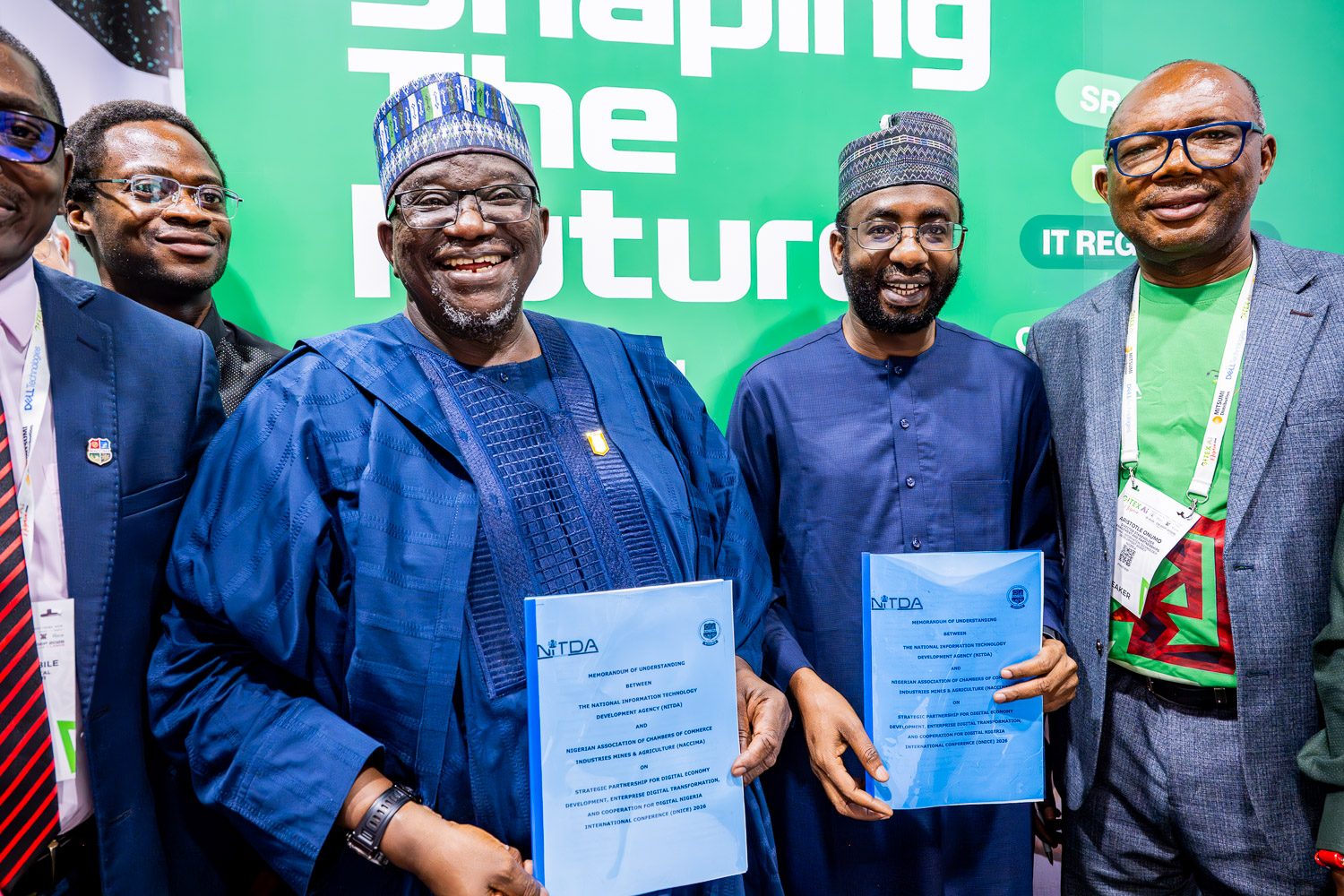
On the sidelines of GITEX Nigeria, the two institutions signed a Memorandum of Understanding (MoU) aimed at accelerating digital transformation, stimulating innovation and helping Nigerian businesses harness technology for growth.
Signed by NITDA Director-General, Kashifu Inuwa Abdullahi, and NACCIMA National President, Engr. Ibrahim Jani, the agreement seeks to build a stronger bridge between Nigeria’s digital policy architecture and the businesses expected to drive economic growth.
But beneath the ceremony, handshakes and formalities lies a much bigger question: Can Nigeria turn its digital ambition into practical opportunities for millions of businesses?
For NACCIMA, the answer requires moving decisively.
“It is an excellent arrangement to have this type of protocol on digitisation and digital transformation, especially for the private sector,” he said.
“NACCIMA is the umbrella body of the organised private sector in Nigeria, and digital transformation is a necessity. There is no better partner to work with than NITDA, and we are happy to sign this MoU and move the partnership forward.”
His argument reflects the reality confronting businesses in an economy increasingly shaped by technology.
Markets are becoming digital. Consumers are changing how they discover and purchase products. Financial transactions are becoming more technology-driven, while artificial intelligence, cloud computing, data analytics and digital platforms are altering how companies operate.
For Nigerian businesses, particularly MSMEs, remaining outside this transformation carries its own risks.
The challenge, however, is that technology adoption requires more than telling businesses to “go digital”.
It requires skills. It requires infrastructure. It requires access to appropriate technology, finance, markets and technical support.
This is where the NITDA-NACCIMA partnership becomes significant.
For years, Nigeria’s digital transformation conversation has largely been driven by government policies, technology companies and the rapidly expanding startup ecosystem.
The new collaboration seeks to push that conversation deeper into the organised private sector.
At the centre of the agreement is the development of a collaborative digital ecosystem platform, alongside initiatives targeting enterprise digital transformation for Micro, Small and Medium Enterprises.
The partnership will also promote digital innovation and technology adoption while creating opportunities for capacity building among Nigerian businesses.
The objective is not simply to put more businesses online. It is to help them use technology to become more productive, innovative and competitive.
For an MSME, that could translate into something as practical as adopting digital accounting, establishing an online presence, using data to understand customers, deploying e-commerce or finding new markets through digital platforms.
In other words, digital transformation is being presented not merely as a technology agenda but as a business survival and growth strategy.
The focus on MSMEs is particularly important.
Nigeria cannot build an inclusive digital economy if digital transformation remains concentrated among large corporations and technology startups.
The real test lies in whether ordinary businesses can participate.
The neighbourhood retailer, small-scale manufacturer, agricultural processor, professional service provider and emerging entrepreneur all form part of the ecosystem that must be connected to Nigeria’s digital future.
NITDA’s partnership with NACCIMA offers a potential mechanism for reaching these businesses through the latter’s extensive network within the organised private sector.
It could also create a stronger feedback loop between businesses and policymakers—allowing the private sector to articulate its technology needs while government institutions design more responsive interventions.
Across the country, young Nigerians are building businesses, developing technology solutions and experimenting with new digital models.
Many young entrepreneurs need mentorship, technical capacity, investment, market access and institutional support to move from promising ideas to sustainable enterprises.
Ibrahim Jani believes Nigeria’s youthful population should be positioned not simply as consumers of technology but as creators and exporters of digital solutions.
“Digitalisation is the way to go. As you can see, we have a youthful population, and they are the ones driving this process,” he said.
“We should encourage them and give them all the necessary support to go beyond Nigeria and compete on the global stage.”
Nigeria’s digital economy will ultimately be judged not only by how many people are connected to the internet, but by how many businesses can use that connectivity to create value, generate employment and compete internationally.
One of the potentially important features of the agreement is its emphasis on building linkages among government institutions, private-sector organisations, technology companies, academia, investors and development partners.
That ecosystem approach recognises a problem that has often confronted innovation efforts: good ideas can struggle when the institutions, capital, expertise and markets required to develop them remain disconnected.
Bringing these actors closer together could create new opportunities for collaboration and investment.
For NITDA, it also provides a channel to take its digital economy mandate closer to the business community.
For NACCIMA, the partnership offers an opportunity to ensure that the private sector is more deeply embedded in Nigeria’s digital transformation agenda.
The agreement also includes strategic cooperation toward the successful development and institutionalisation of the Digital Nigeria International Conference (DNICE) 2026 and subsequent editions.
The significance of this component goes beyond another annual gathering of technology stakeholders.
If properly connected to investment, policy dialogue, business matchmaking and innovation, such platforms can help transform conversations about digital transformation into concrete economic relationships.
The challenge, as always, will be implementation.
Nigeria has no shortage of policies, strategies, conferences and agreements. What businesses often need is the translation of these initiatives into practical support and measurable outcomes.
The NACCIMA President appears conscious of that expectation.
He disclosed that both organisations were prepared to begin implementing the agreement immediately.
“We are going to hit the ground running as soon as we return to our offices for the implementation of this agreement. Nigerians will begin to see things happen almost instantaneously,” he said.
The signing ceremony may have provided the headline, but implementation will provide the story.
The real indicators will be found in the businesses that receive support, the MSMEs that adopt technology, the entrepreneurs who gain access to markets and capital, and the innovations that move from prototypes to commercially viable enterprises.
Nigeria stands at an interesting point in its digital journey.
It has a large and youthful population, an expanding technology ecosystem and an increasing recognition that digital capabilities will shape the competitiveness of its economy.
But potential does not automatically translate into prosperity.
The country must build the bridges between policy and enterprise, innovation and investment, skills and opportunity.
That is the space the NITDA-NACCIMA partnership seeks to occupy.
Its promise lies not in the MoU document itself, but in the possibility of transforming the relationship between government and the private sector around a shared digital agenda.
For Nigerian businesses, the hope is that the partnership will mean fewer barriers to technology adoption, greater access to digital skills and stronger connections to the markets and resources needed to grow.
For young Nigerians, it could mean more pathways to transform digital creativity into scalable businesses.
And for Nigeria as a whole, the larger prize is an economy in which technology is not confined to conference halls, technology hubs and policy speeches, but becomes a practical tool in the hands of millions of businesses.
The photographs from the GITEX Nigeria signing may eventually fade into the archives.
What will matter is whether, months and years from now, Nigerian businesses can look back at that moment and point to the opportunities it helped create.